
★★★★★
Amazing efficiency! Professional installation team! Arizona local and family owned/operated. Couldn’t ask for a better all around group. Always willing to go above and beyond!
Skylight Restoration & Wet Sealing from Sky Design Concepts re-seals aging but structurally sound skylight systems, extending service life without replacing the glazing. Serving Phoenix, Arizona, and the Southwest since 1985, restoration addresses weathered seals and early fiberbloom, often at a fraction of full replacement cost.
Not every aging skylight needs to come off the roof. Skylight Restoration & Wet Sealing extends the life of a system that’s leaking or dulled but still structurally sound, often at a fraction of what full replacement would cost. Sky Design Concepts cleans the gaskets and joints with a high-alcohol concentrate, then re-caulks the curb-to-frame connection so the unit stops leaking without ever pulling the panels.
This service works best on systems 10 to 20 years into their service life, where the failure is isolated to the seal rather than the glazing itself. Our crews evaluate every system across Phoenix and the Southwest before recommending restoration, so building owners get an honest call on whether wet sealing will hold or whether the system has moved past that point.
Restoration and wet sealing re-seal the joints where a skylight meets the roof: the curb-to-frame connection, the fastener points, and the flashing transition. The glazing itself, the dome or panel that lets light through, stays in place. That makes this a different scope than a commercial skylight repair, which patches or re-flashes a specific leak point, and a lower-cost alternative to commercial skylight replacement, which swaps the entire unit.
Restoration works when the frame is structurally sound and the glazing is still clear, just aging at the seal. Once the glazing has cracked, clouded, or fogged between panes, no amount of resealing brings back light transmission or structural integrity; at that point, replacement is the service that fixes the actual problem. Our repair vs. replace guide walks through that line in more detail for a skylight showing multiple symptoms at once.
A skylight does not need a full replacement just because it shows age. These signs point toward resealing instead:
If the glazing is cracked, cloudy, or fogged, restoration will not reach the problem; see the signs covered on our commercial skylight replacement page instead.
Restoration has real limits, and knowing them up front keeps a building owner from paying for resealing work that was never going to fix the actual problem. The table below breaks down what a wet-sealing project addresses component by component:
Component | Does Restoration Fix It? | Explanation |
Curb-to-frame sealant joint | Yes | This is the primary target of a wet-sealing project: strip the old bead, prep the joint, and apply new sealant |
Fastener corrosion (surface-level) | Yes | Corroded fasteners are replaced and re-torqued as part of the same mobilization |
Flashing transition at the roof membrane | Yes | Re-sealed and, where needed, re-flashed alongside the curb joint |
Fiberbloom (early stage, fiberglass/Kalwall panels) | Often | A protective recoat can halt early fiberbloom; advanced cases need replacement |
Cracked or crazed glazing | No | Cracked glazing requires replacement; sealant cannot repair a cracked dome or panel |
Fogging between panes (insulated glass) | No | A failed internal seal on an insulated unit means replacement, not resealing |
Structural frame corrosion or warping | No | A compromised frame needs replacement; resealing a failing frame only delays the inevitable |
Restoration works across nearly every system type we install, provided the glazing and structure are still sound. Here’s what we restore and reseal across Phoenix and the Southwest:
See the full Systems hub for specifications on each product type, or contact us to schedule a free restoration evaluation.
Fiberbloom shows up on fiberglass and Kalwall-type panels once the factory-applied UV-protective surface coating weathers away. Without that coating, the glass fibers underneath are exposed at the surface, producing a chalky, fuzzy texture and a gradual shift toward a dull, washed-out look rather than a clean, translucent panel.
Caught early, before the texture is paired with yellowing or brittleness, a protective recoat and reseal can restore surface clarity and add years to the panel’s service life. Left to advance, fiberbloom progresses to the point where the panel’s structural resin has broken down, and at that stage a recoat has nothing solid left to adhere to; replacement becomes the only fix. An on-site inspection is the only reliable way to tell which side of that line a given panel is on; see our fiberglass and Kalwall-type systems page for more on the material itself.
Sealant failure in Phoenix is driven by two forces working against each other every year. UV exposure dries and shrinks sealant beads over time, and the region’s official monsoon season, June 15 through September 30 according to the National Weather Service Phoenix office, tests every weak seal with wind-driven rain in the same stretch each summer. Scheduling restoration work before the monsoon window opens catches a failing seal before it is tested by the season most likely to turn a small gap into an active leak.
Restoration work still puts a crew on an occupied roof deck, and any skylight opening on that roof is a fall hazard under OSHA’s 29 CFR 1926.501, whether or not the unit itself is being removed. Sky Design Concepts crews stage guardrails or personal fall arrest protection for restoration visits the same way they do for a full replacement; see our skylight fall protection and guards page if a roof’s access points have never been evaluated.
Sealant selection and application practice on commercial buildings is also a field with its own published standards, maintained by organizations like the Sealant, Waterproofing and Restoration Institute. Matching the sealant to the substrate and joint movement it will see is what separates a restoration that holds for a decade from one that fails again in a season.
Restoration follows a focused, repeatable process designed to extend a system’s life without disturbing the glazing itself. Here’s how a typical restoration visit moves from evaluation to finished seal.




| 4.3 | ★★★★★ Google rating 6 Google reviews |
✦ What customers say
Customers describe Sky Design Concepts as professional from start to finish, with a courteous, efficient installation team that goes above and beyond. Reviewers say the installers clean up after the job is done, call the company a local Arizona business, and say they would use it again for future skylight work.
AI-generated summary of customer reviews, updated November 3, 2026.
Amazing efficiency! Professional installation team! Arizona local and family owned/operated. Couldn’t ask for a better all around group. Always willing to go above and beyond!
Courteous & Professional staff. Installers clean up after they’re finished with the projects. Highly recommend
SkyDesign was great to work with start to finish! Very professional and do great work! Will definitely use this company again for any skylight needs
Business Hours:
Monday: 7AM – 4PM
Tuesday: 7AM – 4PM
Wednesday: 7AM – 4PM
Thursday: 7AM – 4PM
Friday: 8AM – 12PM
Saturday: Closed
Sunday: Closed
Sky Design Concepts restores and wet seals commercial skylight systems for contractors, developers, school districts, and property owners throughout Arizona, Nevada, New Mexico, and West Texas. Find your city below, or contact us if your location isn’t listed.
We are proud to provide skylight restoration and wet sealing in Phoenix, AZ, Scottsdale, AZ, Tempe, AZ, Tucson, AZ, Mesa, AZ, Chandler, AZ, Glendale, AZ, Goodyear, AZ, Tolleson, AZ, Gilbert, AZ, Peoria, AZ, and Avondale, AZ, as well as Las Vegas, NV, Henderson, NV, and Reno, NV; Albuquerque, NM, Santa Fe, NM, and Las Cruces, NM; and El Paso, TX, and Midland–Odessa, TX. For a full view of our coverage, see our service area page.
A weathered seal does not always mean a new skylight. If the glazing is still clear and the problem is a dried-out joint, a loose fastener, or early fiberbloom on a fiberglass panel, resealing it now is the lower-cost fix, and it is the kind of maintenance that is far cheaper before the next monsoon season than after a leak has already started.
all (602) 276-5001 or contact us online to schedule a free on-site evaluation and find out whether restoration or replacement is the right call for your roof.
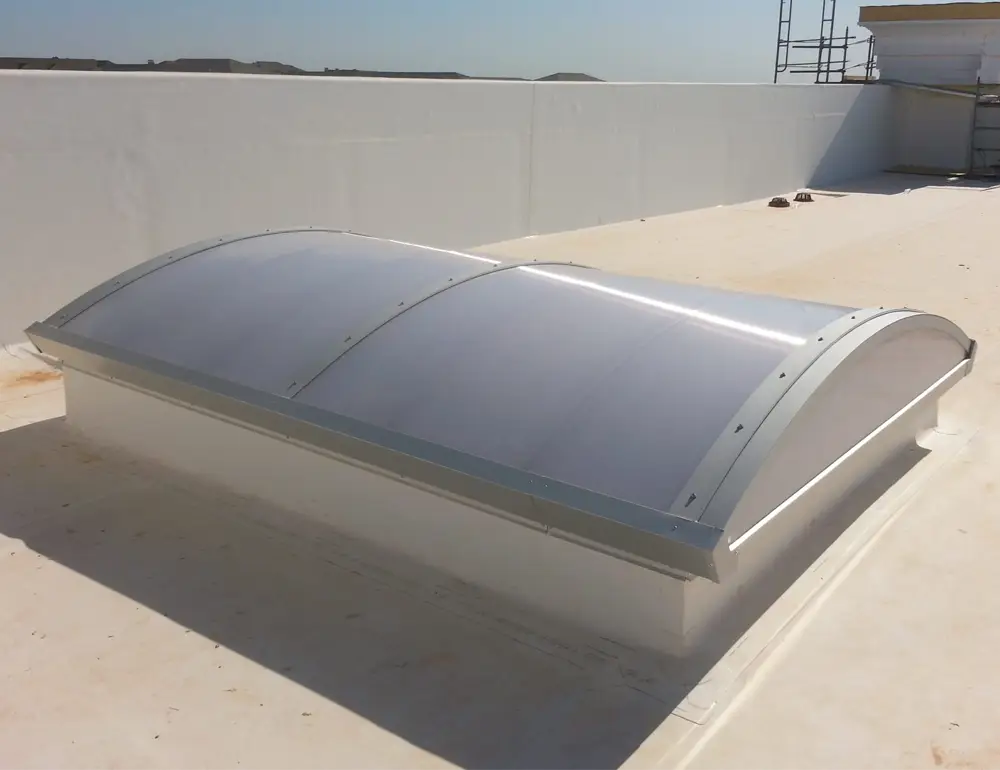
If the glazing is still clear and uncracked and the problem is a weathered seal, loose fasteners, or early fiberbloom, restoration is the right fit. The comparison table above breaks down which components resealing can and cannot fix.
A properly prepped and sealed joint commonly holds for 10 to 15 years before it needs resealing again, though exposure, panel material, and sealant choice all affect that window.
Resealing and recoating are typically maintenance-level work and do not usually trigger the same permit requirements as a full replacement or new installation, since no structural change is involved. A specific project’s scope determines whether the local building department requires anything.
Fiberbloom is the chalky, fibrous surface that appears on fiberglass and Kalwall-type panels once their protective coating weathers away. Caught early, a recoat and reseal can restore the surface; advanced fiberbloom with yellowing or brittleness needs full replacement.
Generally, yes, since the glazing, frame, and curb all stay in place and only the seal and fasteners are serviced. The actual cost difference depends on the number of units and the extent of the sealant failure; a free on-site evaluation gives an accurate comparison for a specific roof.
Most curb-mounted systems, including fiberglass and Kalwall-type, glass, and dome and unit skylights, are restoration candidates when the glazing is sound. An on-site inspection confirms whether a specific system and its current condition qualify.
Getting your commercial skylight project underway is simple, no pressure, no guesswork, just a clear path from inspection to installation.