
★★★★★
Amazing efficiency! Professional installation team! Arizona local and family owned/operated. Couldn’t ask for a better all around group. Always willing to go above and beyond!
Translucent Wall & Roof Assemblies use polycarbonate or FRP panels to diffuse daylight across gymnasiums, warehouses, and schools in Phoenix, Arizona. Sky Design Concepts installs Kingspan Light + Air systems and services existing Kalwall-type panels, diagnosing fiberbloom and seal failure before recommending restoration or replacement.
Translucent wall and roof assemblies are framed systems of light-transmitting panels that replace solid cladding or roofing. The panels pass daylight but not a clear view, so the light inside a gym, warehouse, or school corridor spreads evenly. Most panels are either polycarbonate or fiberglass-reinforced polymer (FRP), and each type has its own frame, seals, and service needs.
Sky Design Concepts, a commercial skylight contractor in Phoenix, installs new translucent systems and replaces and repairs aging ones. We supply Kingspan Light + Air translucent systems, and we service and replace Kalwall-type panels already on your building. Every job starts with a free on-site evaluation.
Arizona sun is hard on translucent panels. Ultraviolet exposure yellows panel faces, exposes the glass fibers in FRP skins, and dries out the sealants and gaskets that keep rain and dust out of the system. A panel that lets less light through than it did when it was installed is usually showing one of these failures.
A translucent wall panel is a light-transmitting cladding panel set in an aluminum frame, either as a continuous wall or as a band of daylight between solid sections. Because the panel diffuses light, the wall brings in daylight without a view of the parking lot and without direct sun on a work surface. Many owners choose translucent wall panels for gymnasiums, distribution centers, and entry walls where privacy and even light matter more than a window view.
Two construction types cover most wall projects. Polycarbonate wall panels use multi-wall sheets for insulation and light diffusion. FRP sandwich panels use fiberglass-reinforced faces over an insulated or grid core and give strong light control and privacy. Kingspan Light + Air’s UniQuad system is a unitized polycarbonate wall with panels up to 38 feet tall, and its UniGrid system (formerly Guardian 275) is an FRP sandwich panel wall that provides light control and privacy.
We install new translucent wall systems, replace failed panels in existing walls, and reseal joints that leak. Where a wall was built with Kalwall panels, we service and replace those too. See our fiberglass and Kalwall-type skylights page for the panel type itself.
A translucent roof panel is a light-transmitting panel set into a roof system. It can be a standing-seam translucent roof, a curb-mounted skylight, or a panel that replaces a section of a metal roof. Translucent roof panels admit daylight across a wide area, so a large floor needs fewer electric lights during working hours.
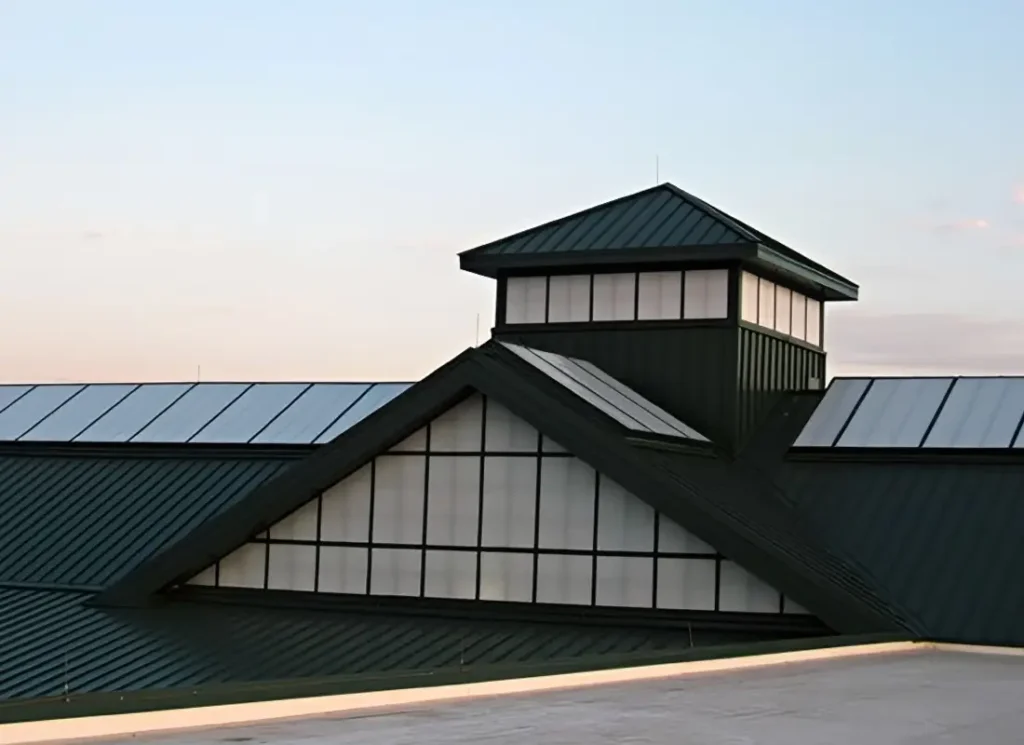
On metal buildings, translucent panels replace sections of the roof to match the rib profile and fastening pattern, which is the most common form of metal building skylight. Kingspan Light + Air’s QuadSpan system is a two-panel translucent skylight with polycarbonate glazing co-extruded with a UV inhibitor and a double-tooth connection for load capacity. CPI Pentaglas and Quadwall systems use honeycomb polycarbonate panels that diffuse light with no glare or hot spots, and they are available in assemblies rated Class A or Class B under ASTM E108 and UL 790.
Translucent roof panels and skylights do not carry foot traffic, so roof crews treat them as fall hazards, and OSHA’s fall protection rules apply to skylights and other roof openings. We install guards, screens, and rails where a roof needs them. See skylight fall protection and guards for options, and our smoke vents and roof hatches page for other roof openings we install and service.
A translucent wall or roof assembly isn’t a single product, it’s a family of panel systems that bring even daylight into large interior spans without the glare a row of windows creates. Here’s what we work with most often.
System | Type | Construction | Best for |
Kingspan UniQuad | Wall | Unitized polycarbonate panels up to 38 ft tall | Tall walls and backlit facades |
Kingspan UniGrid (formerly Guardian 275) | Wall | FRP-faced sandwich panels | Walls that need light control and privacy |
Kingspan QuadSpan | Roof and skylight | Two-panel polycarbonate glazing with UV inhibitor | Daylighting large roof areas |
CPI Pentaglas and Quadwall | Wall and roof | Honeycomb polycarbonate, Class A or B roof assemblies available | Diffuse daylight with low glare |
Kalwall-type FRP sandwich panels | Wall and roof | FRP faces on an insulated grid core | Service and replacement of existing panels |
Model names and ratings come from the manufacturers. We confirm the current product, light transmission, and fire rating for your project during the evaluation.
Translucent assemblies suit buildings with large floors, high ceilings, and long hours of daytime use. The most common projects fall into these groups:
Translucent panels fail in a few predictable ways, and the right fix depends on which one is actually happening. Here’s what we see most often and how each gets addressed.
Condition | What you see | Typical fix |
Yellowing or haze | Panels look amber or cloudy and the room is darker | Replace the panels; yellowing signals the end of service life |
Fiberbloom | Glass fibers show through the face of an FRP panel | Evaluate on site; replace panels when the surface is breaking down |
Leaking joints | Stains, drips, or water at the base of the wall or roof panel | Reseal joints and gaskets; replace the seal system if it has failed |
Cracked or broken panel | Visible cracks, chips, or holes | Replace the panel and check the frame |
Condensation or delamination | Moisture between layers or faces separating | Replace the affected panel; the seal has failed |
Fiberbloom is the same UV-driven surface breakdown tracked across the industry’s fiberglass and FRP panel literature, including research published by the Lawrence Berkeley National Laboratory on daylighting system performance and degradation over time.
Translucent wall and roof assemblies don’t fail all at once, they show specific signs long before a panel needs full replacement. Here’s what our crews look for during an evaluation.
Many translucent wall and roof assemblies can be repaired before they need replacement. We replace failed gaskets and sealants, reseal leaking joints, and replace individual cracked or broken panels. When the faces are yellowed, the fibers show through, or the panels have lost their bond, replacing the panels restores light levels that resealing cannot. Our guide to deciding between repair and replacement explains the same decision for skylights, and we apply it to wall and roof panels.
For leaks at joints and curbs, see skylight restoration and wet sealing. For panel and frame repairs, see commercial skylight repair. When a full system has reached the end of its service life, see commercial skylight replacement. For new assemblies, see commercial skylight installation.
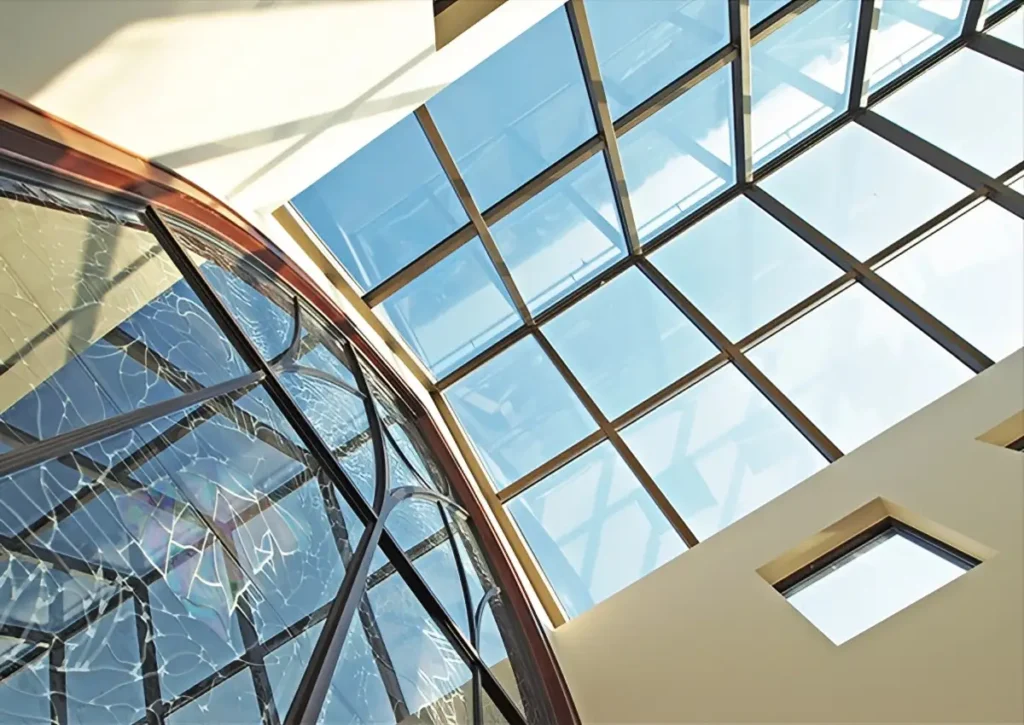
Translucent panels, glass skylights, and unit skylights all admit daylight, and each fits a different job. Translucent panels diffuse light across a wide area and suit walls and large roof sections. Glass skylights give a clear view of the sky and suit atriums and lobbies. Dome, unit, and polycarbonate skylights are standard-size, curb-mounted units that fit most flat roofs.
For large or unusual openings, see custom and monumental skylights. When the roof opening also needs ventilation, see retractable and operable skylights. For a full list of types, browse all skylight systems.
Cost depends on the system, the size of the assembly, and the condition of the structure behind it. These factors move the price most:
The free on-site evaluation gives you a written scope with the cost for your building.
Large-format panel systems carry the same careful diagnosis as any skylight, scaled to a full wall or roof section rather than a single opening. Here’s how a typical project moves from first inspection to final seal.





| 4.3 | ★★★★★ Google rating 6 Google reviews |
✦ What customers say
Customers describe Sky Design Concepts as professional from start to finish, with a courteous, efficient installation team that goes above and beyond. Reviewers say the installers clean up after the job is done, call the company a local Arizona business, and say they would use it again for future skylight work.
AI-generated summary of customer reviews, updated November 3, 2026.
Amazing efficiency! Professional installation team! Arizona local and family owned/operated. Couldn’t ask for a better all around group. Always willing to go above and beyond!
Courteous & Professional staff. Installers clean up after they’re finished with the projects. Highly recommend
SkyDesign was great to work with start to finish! Very professional and do great work! Will definitely use this company again for any skylight needs
Business Hours:
Monday: 7AM – 4PM
Tuesday: 7AM – 4PM
Wednesday: 7AM – 4PM
Thursday: 7AM – 4PM
Friday: 8AM – 12PM
Saturday: Closed
Sunday: Closed
Sky Design Concepts services, repairs, and installs translucent wall and roof panel assemblies for contractors, developers, school districts, and property owners throughout Arizona, Nevada, New Mexico, and West Texas.
We are proud to provide translucent wall and roof assembly service in Phoenix, AZ, Scottsdale, AZ, Tempe, AZ, Tucson, AZ, Mesa, AZ, Chandler, AZ, Glendale, AZ, Goodyear, AZ, Tolleson, AZ, Gilbert, AZ, Peoria, AZ, and Avondale, AZ, as well as Las Vegas, NV, Henderson, NV, and Reno, NV; Albuquerque, NM, Santa Fe, NM, and Las Cruces, NM; and El Paso, TX, and Midland–Odessa, TX. For a full view of our coverage, see our service area page.
A translucent wall or roof assembly covers a lot of ground, which means a small seal failure or an early patch of fiberbloom only gets more expensive to fix the longer it sits across that much panel area. Sky Design Concepts inspects the full assembly, joint by joint, and tells you honestly whether a section needs resealing, a targeted panel swap, or a full replacement, backed by manufacturer-grade product knowledge rather than a guess from the ground.
Call us at (602) 276-5001 to schedule your free on-site evaluation today.
Translucent wall and roof assemblies are framed systems of light-transmitting panels that replace solid cladding or roofing. The panels pass diffuse daylight but not a clear view. Most use polycarbonate or fiberglass-reinforced polymer (FRP), and each system includes the frame, seals, and flashing.
Translucent panels diffuse light across a wide area, and glass skylights give a clear view of the sky. Diffused light avoids glare and hot spots on floors and work surfaces, while a clear view suits atriums and lobbies. See our glass skylights page for that option.
Diffusing panels avoid direct glare, and heat gain depends on the panel build. Manufacturers offer a range of light transmission and shading levels, so we match the panel to the side of the building and its sun load.
Panels need replacement when yellowing, fiberbloom, delamination, or cracking has reduced light transmission or broken the seal. Service life depends on the panel type, sun exposure, and upkeep, and Arizona sun speeds up the wear on fiberglass panels. We inspect the building and tell you whether to reseal or replace; our repair or replace guide covers the decision.
Yes. We service and replace Kalwall-type fiberglass sandwich panels, including the panels, seals, and flashing around them. See fiberglass and Kalwall-type skylights for the panel details.
Yes. Translucent roof and wall panels can replace sections of a metal building’s roof or wall, and we match the panel to the rib profile, framing, and fastening pattern. We also confirm wind, load, and fire requirements before work starts.
No. Translucent roof panels and skylights do not carry foot traffic, so treat them as fall hazards. We install guards, screens, and rails where a roof needs them; see skylight fall protection and guards.
Getting your commercial skylight project underway is simple, no pressure, no guesswork, just a clear path from inspection to installation.