
★★★★★
Amazing efficiency! Professional installation team! Arizona local and family owned/operated. Couldn’t ask for a better all around group. Always willing to go above and beyond!
Commercial Skylight Replacement from Sky Design Concepts swaps failing skylight systems, fiberglass, glass, or dome, once repair or restoration no longer holds. Serving Phoenix, Arizona, and the Southwest since 1985, every replacement includes permit coordination, NFRC-rated glazing options, and four-level warranty coverage, confirmed through a free on-site evaluation.
Sky Design Concepts has provided Commercial Skylight Replacement services across Phoenix and the Southwest since 1985, stepping in once a skylight system has moved past the point where a repair or reseal will hold. Whether it’s fiberglass panels that have yellowed beyond restoration, glass units with failed seals throughout, or dome skylights original to a building built decades ago, our factory-certified crews remove the old system and install new panels matched to the roof opening.
Sky Design Concepts works on warehouses, schools, hospitals, municipal buildings, and retail centers, backing every replacement with warranty coverage at four levels, manufacturer, glazing, finish, and labor. Every job starts with a free on-site evaluation and a written scope, so building owners know exactly what’s being replaced and why before a crew ever returns to the roof.
Replacement means the old skylight comes off the curb and a new unit goes on, built to current code and sized to fit the existing roof opening. That is a different scope than a commercial skylight repair, which seals, patches, or re-flashes a unit that still has useful life left in it, and different again from a new commercial skylight installation, which cuts a fresh opening into a roof that never had one.
There is also a middle tier worth ruling out before a full replacement gets ordered. Skylight restoration and wet sealing can extend the life of a frame and curb that are structurally sound but weathered, re-sealing the glazing-to-frame joint and the curb-to-roof transition without pulling the unit. That option works when the glazing itself is still clear and uncracked and the failure is isolated to the seal, not the dome or panel.
If the frame is pitted, the gasket has hardened, or the dome has gone brittle from UV exposure, repair or restoration work buys a short window at best. Replacement resets the clock: new glazing, new frame, new curb seal, and a warranty on the finished assembly. For buildings where it is not clear which stage a skylight is in, our repair vs. replace guide walks through the inspection points that settle the question before any crew sets foot on the roof.
A building owner usually knows something is wrong before a contractor shows up. Each of the signs below points to a different failure mode, and most of them get worse, not better, if a crew simply re-seals the surface and moves on:
If three or more of these apply, replacement is almost always the lower lifetime cost compared to a cycle of repeated repair calls on the same unit.
Building owners rarely start with “I need a replacement.” They start with a symptom, a leak, a stain, a crack, and need to know which service actually fixes it. The table below maps the most common symptoms to the service tier that resolves them and why, so the right crew gets scheduled on the first call instead of the second one.
Symptom Observed | Likely Cause | Recommended Service | Why This Tier |
Minor drip during rain, glazing still clear | Isolated seal or flashing gap | Commercial Skylight Repair | Glazing has life left; the leak path is localized and patchable |
Weathered curb seal, frame sound, no cracks | Aged sealant, UV-dried gaskets | Restoration & Wet Sealing | Re-seals the full curb-to-frame joint without replacing the glazing |
Leak returns after a prior repair | Failure at the frame-to-curb connection | Commercial Skylight Replacement | Repair-tier sealing cannot reach a structural connection failure |
Yellowed, clouded, or cracked dome | UV degradation or thermal cracking of the glazing | Commercial Skylight Replacement | Glazing damage does not reverse; only a new unit restores clarity and strength |
Fogging between panes on an insulated unit | Failed insulated-glass seal | Commercial Skylight Replacement | The sealed gas gap cannot be restored once it has failed |
New roof opening, no existing skylight | N/A, new construction or remodel | Commercial Skylight Installation | No existing curb or unit to repair, restore, or replace |
Glazing material drives most of the difference in service life, and manufacturer warranties back that up. VELUX’s commercial warranty terms, for example, cover acrylic and polycarbonate domes against yellowing past a set index for five years and against cracking for up to fifteen, while insulated glass units are typically warrantied against seal failure for twenty years, longer timelines than the plastics but not permanent ones either.
Phoenix’s climate accelerates at the low end of every range below: roughly 300 sunny days a year, 111 days a year at or above 100°F, and an official monsoon season (June 15 through September 30, per the National Weather Service) that brings wind-driven rain and dust loading against curb seals.
Glazing Material | Typical Industry Service Life | Phoenix Climate Factor | Best Suited For |
Acrylic dome | 10-20 years | Fastest to yellow under UV load; shortest end of range common locally | Budget-sensitive replacements, lower-traffic roofs |
Polycarbonate dome | 15-25 years | Strong impact resistance but still UV-sensitive without a coated cap sheet | Warehouses, schools, high-impact-risk areas |
Insulated glass unit | 20-30 years | UV-stable; seal failure (fogging) is the main local failure mode | Architectural, lobby, and high-visibility installs |
Fiberglass/Kalwall-type panel | 20-30 years | Diffuses UV rather than degrading under it; handles monsoon wind load well | Wide-span warehouse and gymnasium daylighting |
These are industry-published ranges, not a guarantee on any specific unit. Roof orientation, drainage, and maintenance history all shift a given skylight up or down within its material’s range, which is exactly what an on-site evaluation is for.
Replacing a commercial skylight in Phoenix is permitted work in most cases, since it touches the roof assembly and, depending on scope, the structural curb. The City of Phoenix Planning & Development Department issues roofing and roof-opening permits and can confirm whether a given project needs plan review before work starts. Sky Design Concepts handles permit coordination as part of the replacement scope, so the paperwork does not fall on the building owner.
New skylight glazing is also rated for energy performance. U-factor and solar heat gain coefficient ratings, certified through the National Fenestration Rating Council, tell a building owner how much heat a new unit will gain or lose compared to the one coming off the roof. That number carries real weight in Phoenix, where cooling, not heating, drives most of a commercial building’s energy bill across 111-plus days a year above 100°F. Our daylighting consulting team can walk through glazing options and their rated performance before a replacement is ordered.
Climate is also why timing matters. The National Weather Service Phoenix office marks the region’s monsoon season as June 15 through September 30, and scheduling a replacement outside that window, where possible, keeps an open roof curb away from wind-driven monsoon rain during the install.
Any crew working on a roof with open skylight curbs is also covered by OSHA’s fall protection standard, 29 CFR 1926.501, which treats an uncovered skylight opening the same as any other roof hole more than six feet above a lower level. Sky Design Concepts crews stage guardrails, covers, or personal fall arrest systems before the old unit comes off, not after, and that standard is one reason a permanent fall protection guard is worth pricing alongside the replacement itself for any roof with regular maintenance access.
Every project is priced after an on-site look, since no two curbs, roofs, or access points are the same, but the factors that move a quote up or down are consistent:
The right replacement depends on the building type, the existing curb size, and what the roof needs to do beyond let in light. Our systems line-up covers:
We install and service units from Kingspan Light + Air, VELUX Commercial, Sunoptics, Bilco, American Skylights, and Acralight, matched to the application rather than sold as a one-size-fits-all product. See the full manufacturers list for brand-specific warranty and product detail.
Not every replacement job looks the same. A warehouse or industrial facility usually needs wide-span Kalwall-type or dome units sized for roof-deck spacing and load, often replaced in batches across a single roof rather than one unit at a time, since a facility manager typically wants one mobilization to cover every failing unit instead of repeat visits.
Schools and education facilities carry their own scheduling and safety constraints, since replacement work typically happens on a school break or weekend to keep crews and open roof curbs away from occupied classrooms and playgrounds during school hours.
Every replacement follows the same structured path, from first inspection to final warranty paperwork, so building owners know exactly what to expect at each stage. Here’s how a typical project moves from evaluation to completion.


| 4.3 | ★★★★★ Google rating 6 Google reviews |
✦ What customers say
Customers describe Sky Design Concepts as professional from start to finish, with a courteous, efficient installation team that goes above and beyond. Reviewers say the installers clean up after the job is done, call the company a local Arizona business, and say they would use it again for future skylight work.
AI-generated summary of customer reviews, updated November 3, 2026.
Amazing efficiency! Professional installation team! Arizona local and family owned/operated. Couldn’t ask for a better all around group. Always willing to go above and beyond!
Courteous & Professional staff. Installers clean up after they’re finished with the projects. Highly recommend
SkyDesign was great to work with start to finish! Very professional and do great work! Will definitely use this company again for any skylight needs
Business Hours:
Monday: 7AM – 4PM
Tuesday: 7AM – 4PM
Wednesday: 7AM – 4PM
Thursday: 7AM – 4PM
Friday: 8AM – 12PM
Saturday: Closed
Sunday: Closed
Sky Design Concepts replaces commercial skylight systems for contractors, developers, school districts, and property owners throughout Arizona, Nevada, New Mexico, and West Texas.
We are proud to provide commercial skylight replacement in Phoenix, AZ, Scottsdale, AZ, Tempe, AZ, Tucson, AZ, Mesa, AZ, Chandler, AZ, Glendale, AZ, Goodyear, AZ, Tolleson, AZ, Gilbert, AZ, Peoria, AZ, and Avondale, AZ, as well as Las Vegas, NV, Henderson, NV, and Reno, NV; Albuquerque, NM, Santa Fe, NM, and Las Cruces, NM; and El Paso, TX, and Midland–Odessa, TX. For a full view of our coverage, see our service area page.
Stop paying for repairs that do not hold. If a skylight is cracked, clouded, leaking after a prior repair, or simply old enough to be past its glazing’s service life, a full replacement is a one-time fix that comes with a new warranty instead of another invoice in six months, and Sky Design Concepts will walk the roof, confirm which tier of work the unit actually needs, and quote the job on the spot during a free on-site evaluation.
Call (602) 276-5001 or contact us online to get a replacement scheduled before the next monsoon season tests every weak seal on the roof.
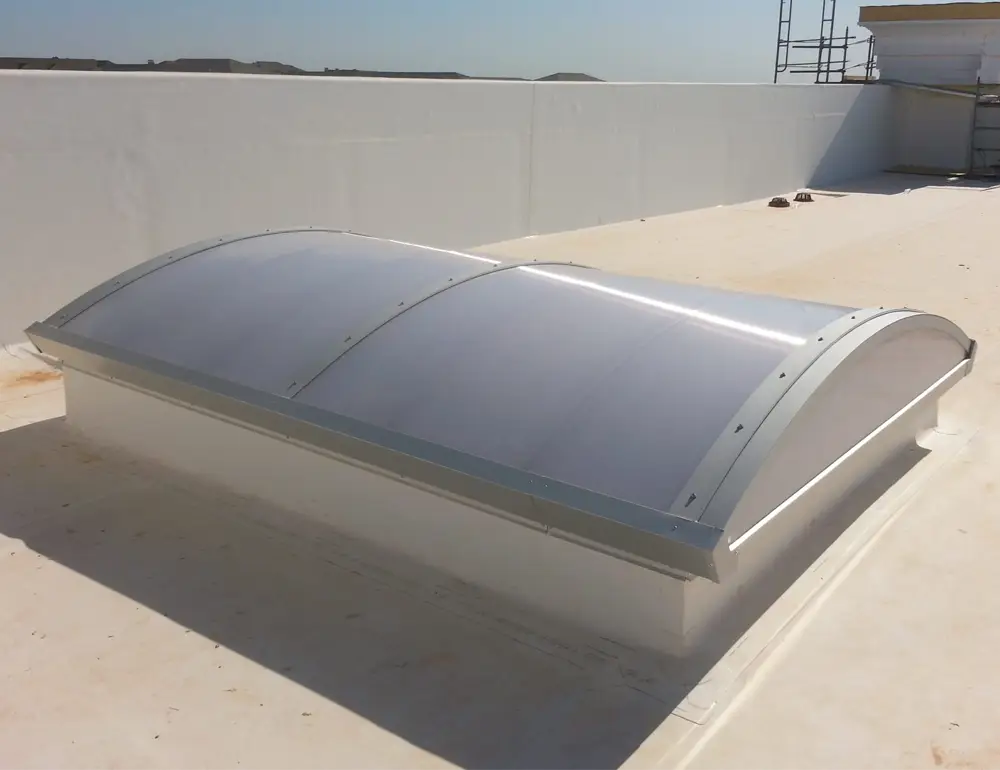
If the glazing is cracked, cloudy, or leaking after more than one repair attempt, replacement is the more reliable fix. The comparison table above, and our repair vs. replace guide, both cover the specific signs to check before calling a contractor.
A single-unit replacement is typically a one-day job once permits are in hand. Multi-unit warehouse or school projects run longer, scheduled around the building’s operating hours and, where possible, outside the June 15 to September 30 monsoon window.
In most cases, yes. The City of Phoenix Planning & Development Department requires a permit for roof-opening work; Sky Design Concepts handles the application as part of the project scope.
Arizona, Nevada, and New Mexico. We also travel to West Texas markets, including El Paso and Midland-Odessa, as a service-area contractor, without holding a Texas contractor license there.
Kingspan Light + Air, VELUX Commercial, Sunoptics, Bilco, American Skylights, and Acralight, selected by application rather than a single preferred brand. See our full manufacturers list.
Not automatically. Fall protection, whether a screen, guard, or rated cover, is a separate line item we recommend for any roof with walking/working access; see our skylight fall protection and guards page for options.
Often, yes. Current glazing carries NFRC-rated U-factor and solar heat gain numbers that older units typically do not meet. Ask our daylighting consulting team to compare your existing unit’s performance to current options.
Restoration re-seals a sound frame and curb without touching the glazing; replacement swaps the entire unit. Our skylight restoration and wet sealing page covers which symptoms point to restoration instead.
Getting your commercial skylight project underway is simple, no pressure, no guesswork, just a clear path from inspection to installation.